
Germany Opportunity Card 2026: Move to Germany to Find a Job — No Sponsor Needed
If you have been hunting for a sponsor to get you a job abroad, Germany offers something that works the other way around. The Opportunity Card, or Chancenkarte, lets qualified non-EU workers move to Germany for up to a year to look for a job — without a job offer and without a sponsor lined up first. In a world where most “work abroad” routes demand an employer sponsor before you can even apply, that is a genuinely different door.
But it is not a free pass, and it is not a job. Here is the honest, up-to-date picture for 2026 — who really qualifies, what it costs, the catch most guides skip, and how to avoid the agents who prey on hopeful applicants.
Quick answer: The Germany Opportunity Card (Chancenkarte) is a residence permit that lets skilled non-EU nationals live in Germany for up to 12 months to search for a qualified job — no prior job offer required. You qualify either with a recognized degree or vocational qualification, or by scoring at least 6 points on a points system, and by proving you can support yourself financially.
What the Opportunity Card actually is
The Chancenkarte was introduced on 1 June 2024 under Section 20a of the German Residence Act, as part of Germany’s Skilled Immigration Act. It exists because Germany faces a large, ongoing shortage of skilled workers and wants to attract talent directly, rather than waiting for employers to sponsor every hire.
The card is issued for a maximum of 12 months. During that time you are allowed to work part-time — up to 20 hours per week in any sector — and to take short “trial” jobs (Probebeschäftigung) of up to two weeks per employer, with no cap on how many trials you do. That part-time and trial flexibility is deliberate: it lets you earn something and prove yourself to employers while you search.
The crucial thing to understand is that the Opportunity Card is a job-search permit, not an employment visa. It does not come with a job, and it does not guarantee one. It simply puts you legally inside Germany’s labour market so you can find qualified work.
Why the Opportunity Card is getting so much attention in 2026
A few things have pushed the Chancenkarte back into the spotlight this year:
- Fully digital applications. Germany has moved consular services onto a digital Consular Services Portal, which has made applying more transparent and sped up processing in 2026.
- Refreshed 2026 numbers. The financial proof requirement, minimum wage, and EU Blue Card salary thresholds were all updated for 2026 (details below), so a lot of older guidance is now out of date.
- An expanded shortage-occupations list. Germany’s shortage list (Mangelberufe) for 2026 spans STEM, healthcare, education and public services, and various technical trades — widening who benefits from bonus points.
- Real first-year data. According to German government figures, roughly 11,497 Opportunity Cards were issued between June 2024 and mid-2025, with India the single largest source country, followed by China and Turkey. That is strong demand — though it also came in below the government’s early projection of around 30,000 a year, a useful reality check we will come back to.
The two ways to qualify
There are two routes, and you only need to satisfy one.
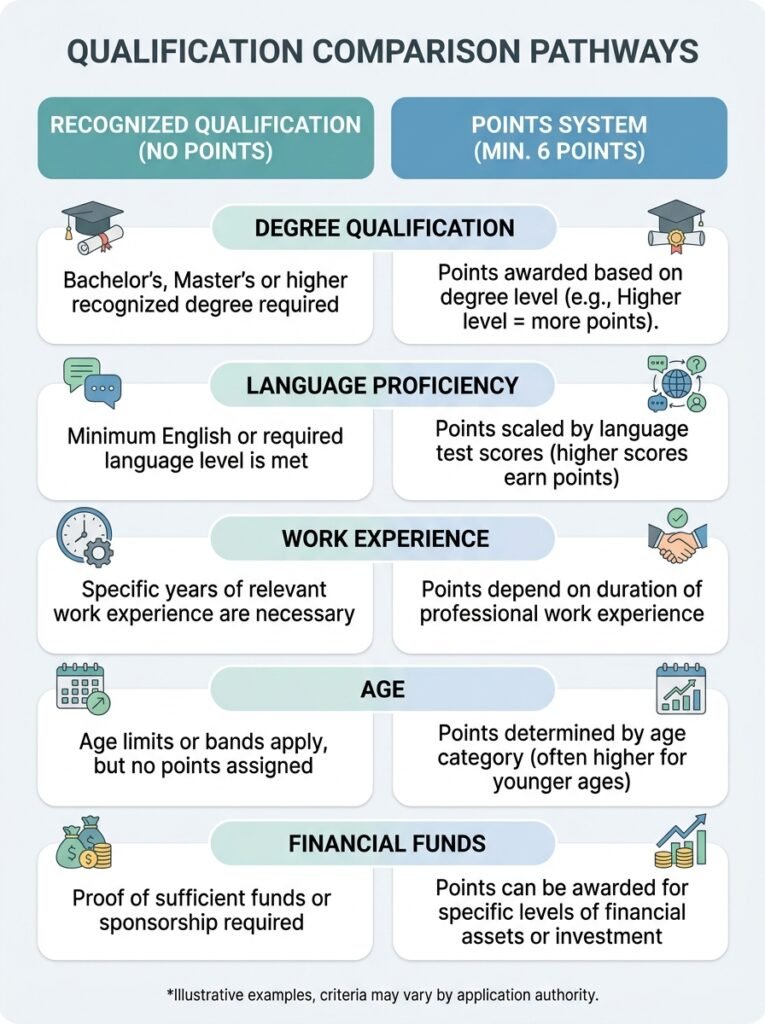
Route 1 — Recognized qualification (no points needed). If you hold a foreign university degree or a vocational qualification of at least two years that is fully recognized in Germany, you qualify automatically as a skilled worker. You still have to meet the financial and language basics, but you skip the points test. Academic recognition is checked through the ANABIN database; your qualification generally needs an “Entspricht” or “Gleichwertig” (equivalent) rating, and vocational qualifications are assessed through the relevant German recognition bodies.
Route 2 — Points system (minimum 6 points). If your qualification is not fully recognized yet, you can still qualify by scoring at least six points on the Chancenkarte points grid — provided you hold a completed academic or vocational qualification recognized in the country where you earned it, and you meet a baseline language level.
How the points system works
The points system rewards the things that make you employable in Germany. You need at least six points in total, drawn from categories such as:
- Partial recognition of your qualification (a strong single contributor).
- Work experience — several years of relevant experience earns points, with longer experience (for example five years within the last seven) scoring more.
- Language skills — German counts for more than English here. Higher German levels (A2, B1, B2 and above) earn progressively more points, while English at an advanced level can add some too.
- Age — younger applicants score more, with the highest band typically for those under 35.
- Qualification in a shortage occupation.
- Previous ties to Germany, such as an earlier period of study, language learning, or work.
- A spouse or partner applying jointly — each can earn a bonus point.
Because the exact point values are set by the German government and can be adjusted, do not rely on any blog’s table — including this one — as final. Use the official “Make it in Germany” self-check tool to calculate your real score before you spend money on the application.
The money you need to prove
You must show you can support yourself during the job search. For 2026, the reported financial requirement is at least €1,091 per month, which works out to about €13,092 for the year. You can usually prove this in one of a few ways:
- A blocked account (Sperrkonto) holding the required annual amount — the most widely accepted method.
- A formal declaration of commitment from a sponsor in Germany.
- A part-time job contract in Germany within the 20-hour limit that pays enough to cover your living costs.
It helps to know that Germany’s statutory minimum wage rose to €13.90 per hour from January 2026. At the full 20 hours a week, minimum-wage part-time work lands close to the monthly figure you need to prove — which is why the part-time allowance matters so much in practice.
What you can and can’t do on the card
To be clear about the boundaries:
- You can stay up to 12 months, work up to 20 hours per week, and take unlimited two-week trial jobs.
- You cannot work full-time on the Opportunity Card itself, and it does not by itself grant permanent residence.
- If you secure a qualifying job offer but cannot yet convert your status, a follow-up Opportunity Card (Anschluss- or Folge-Chancenkarte) of up to two additional years may be granted.
- Family reunification is restricted while you are only job-searching. Most families wait until the main applicant converts to a proper work permit — such as the EU Blue Card — before bringing dependants over.
After you find a job: converting the card
The Opportunity Card is designed as a bridge to long-term residence. Once you land a qualified role, you book an appointment at the local immigration office (Ausländerbehörde) to convert the card into a proper work permit or, if you qualify, an EU Blue Card.
The EU Blue Card thresholds were raised on 1 January 2026. The standard minimum salary is now €50,700 gross per year, while shortage occupations, recent graduates, and qualifying IT specialists can qualify at a reduced €45,934.20 gross per year. These figures are recalculated annually under a fixed German formula, so always confirm the current number for your occupation before you negotiate salary. IT specialists can, notably, reach a Blue Card without a formal degree through the experience-based pathway, provided the salary and experience conditions are met.
Who this really works for — and who it doesn’t
This is where most guides go quiet, so let’s be straight.
The Opportunity Card suits you if you have a recognized degree or solid vocational training, some savings to fund a few months abroad, decent German or strong English, and the drive to job-hunt hard on the ground. Skilled workers in IT, engineering, healthcare and skilled trades tend to have the strongest odds.
It may not suit you if you cannot self-fund the stay, your qualification will not pass recognition, you need to bring your family immediately, or you are expecting a guaranteed job. Remember that first-year data point: far fewer cards were issued than projected, and holding the card is only the start — you still have to compete for and win a job inside a limited window. Going in with clear eyes protects your money and your time.
How to apply, step by step
- Run the official self-check. Use the “Make it in Germany” Opportunity Card self-check to confirm your route and estimate your points.
- Check qualification recognition. Look up your degree or institution on ANABIN, or start the vocational recognition process, well before you apply — this is where many applications fail.
- Sort your finances. Open a blocked account or arrange another accepted proof of the ~€13,092 you need.
- Prepare documents. Valid passport, qualification certificates and transcripts, proof of recognition, language certificate, and financial proof. Some documents need certified translation and apostille.
- Apply through the consular portal. Create an account on the digital Consular Services Portal, submit online, then attend a biometric appointment at the German embassy or consulate. Budget for the application fee (around €75) plus separate recognition, translation and apostille costs.
- Wait for the decision — typically a few months, varying by mission.
- After arrival, register within two weeks. Complete your address registration (Anmeldung) at the local office, then begin your job search and use the trial-employment option freely.
A serious scam warning
Because this route is popular and emotional, it attracts fraud. Protect yourself:
- The official application goes through the German consular portal and embassy — not through a private “agent” who guarantees approval.
- No one can guarantee you an Opportunity Card or a German job. Anyone promising a “100% guaranteed visa” for a large upfront fee is a red flag.
- You do not pay a company for a Certificate of Sponsorship on this route — the whole point of the Chancenkarte is that no sponsor is required.
- Verify every figure — financial proof, salary thresholds, points — on Make it in Germany, BAMF, or your German mission’s site, not on a recruiter’s WhatsApp message.
Key Takeaways
- The Germany Opportunity Card 2026 is a 12-month job-search residence permit for skilled non-EU workers — no job offer or sponsor needed.
- Qualify via a recognized qualification or by scoring at least 6 points, plus a language baseline (German A1 or English B2).
- Prove about €1,091/month (≈€13,092/year); you may work 20 hours/week and take two-week trial jobs while searching.
- After a job offer, convert to a work permit or EU Blue Card (2026 thresholds €50,700 / €45,934.20).
- It is a job-search permit, not a job — self-fund realistically, verify everything on official portals, and never pay for a “guaranteed” visa.
also read: germany-citizenship-rules-2026/
FAQ
Q1. What is the Germany Opportunity Card (Chancenkarte)? It is a residence permit under Section 20a of the German Residence Act, introduced in June 2024, that lets skilled non-EU nationals live in Germany for up to 12 months to search for a qualified job without a prior job offer.
Q2. How many points do you need for the Opportunity Card in 2026? You need a minimum of six points on the Chancenkarte points system if your qualification is not fully recognized. Points come from work experience, language ability, age, ties to Germany and more. If your qualification is fully recognized, you skip the points test entirely.
Q3. How much money do you need to show for the Opportunity Card? For 2026 the reported requirement is at least €1,091 per month, roughly €13,092 for the year, usually shown through a blocked account, a declaration of commitment, or an adequate part-time job contract. Verify the current figure on official German portals.