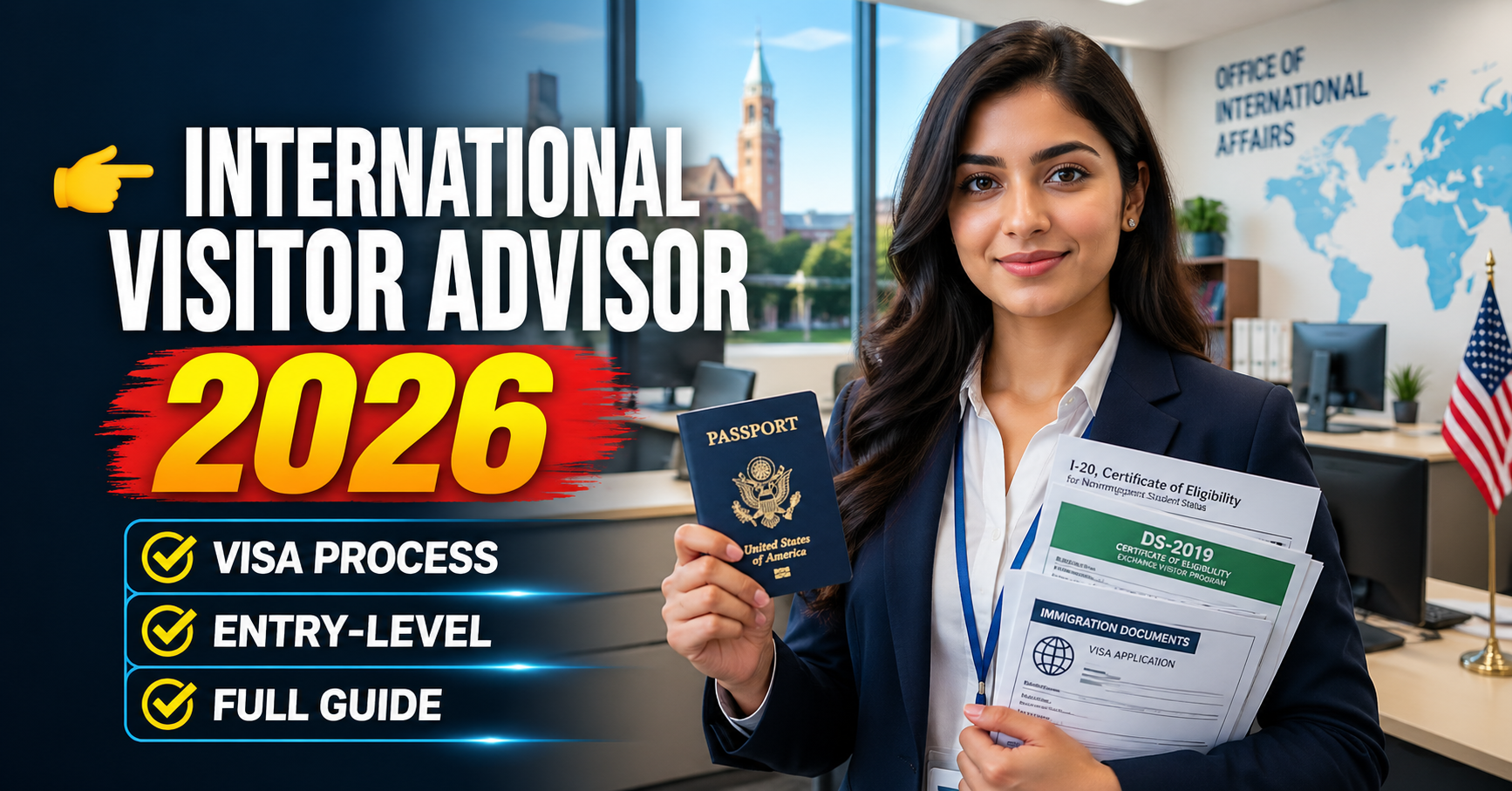
An International Visitor Advisor (often titled International Student & Scholar Advisor) works in the international office of a US university, research institution or hospital, helping international students and visiting scholars navigate US immigration rules. It’s a rewarding, people-focused career — but if you’re a foreign national hoping this role will sponsor your own US visa, there’s an important legal reality you need to know first, which this guide explains honestly along with the duties, requirements and salary.
What the role involves
- Advising F-1 students and J-1 exchange visitors on maintaining their immigration status
- Issuing and updating immigration documents (Form I-20 for F-1; DS-2019 for J-1) and maintaining SEVIS records
- Guiding students on work authorization (CPT/OPT), travel signatures, program extensions and address changes
- Reporting required information to the Department of Homeland Security and Department of State
- Running orientations and supporting cross-cultural transition
The visa reality you must understand
This is the part many job ads skip. The advisor usually serves as a Designated School Official (DSO) for the F-1 program and/or a Responsible Officer (RO/ARO) for the J-1 program. By federal regulation (8 CFR 214.3), a DSO must be a US citizen or a lawful permanent resident — and similar rules apply to J-1 Responsible Officers. In plain terms: the core advisor role generally cannot be filled by a foreign national on a temporary visa, so it is usually not a visa-sponsorship opportunity. You typically need to already hold US citizenship or a green card.
There may be junior or support positions within an international office that don’t carry DSO/RO duties, but the certified advisor function itself is restricted.
Requirements
- A bachelor’s degree (a master’s is often preferred for senior roles)
- Knowledge of F-1 and J-1 regulations and SEVIS
- Strong attention to detail and confidentiality with sensitive records
- Excellent cross-cultural communication skills
- US citizenship or lawful permanent residence for DSO/RO duties
New advisors typically complete SEVP’s online training (SETA) and learn on the job under an experienced PDSO.
Salary
Pay varies by institution and region, but International Visitor Advisor roles commonly fall in the region of USD $45,000–$65,000 per year, with senior or director-level roles paying more.
If you’re a foreign national
Because of the citizenship/green-card requirement for DSO/RO duties, the realistic route into this career is to first obtain permanent residence, then build experience in an international-education setting. In the meantime, related campus roles (admissions, student services) can be useful stepping stones.
Avoiding scams
- Be wary of any ad promising US “visa sponsorship” for an international student advisor role — the core role legally requires citizenship or a green card.
- No agent can guarantee a US work visa; only the relevant US authorities decide.
- Never pay an “agent” for a job offer or sponsorship.
Frequently asked questions
Can a person on an F-1 or H-1B visa become a DSO?
No. Federal rules require a DSO to be a US citizen or lawful permanent resident.
What’s the difference between a DSO and an RO?
A DSO administers the F-1 student program (DHS); a Responsible Officer administers the J-1 exchange visitor program (Department of State). One advisor often holds both roles.
Do I need a law degree?
No — it’s an advising and compliance role, not a legal-practice role, though strong knowledge of the regulations is essential.
Disclaimer: This is a general guide based on publicly available official information current at the time of writing. US immigration regulations change — always confirm the latest requirements with official DHS/SEVP and Department of State sources before relying on this information.