
Germany Opportunity Card 2026: How the Points System Works and Who Actually Qualifies
Germany’s Opportunity Card, known in German as the Chancenkarte, is the rare work-migration route that lets you move first and find the job after. It is a points-based residence permit that allows skilled non-EU professionals to live in Germany for up to 12 months and search for qualified work — without needing a job offer before they arrive. For anyone eyeing Europe’s largest economy in 2026, it is one of the most realistic legal pathways available.
But “no job offer needed” is where most guides stop and where most applicants get confused. The Opportunity Card gets you into Germany to look; a different visa, the EU Blue Card, is usually what you convert to once you land a role — and its salary thresholds changed on 1 January 2026. This guide keeps those two things separate and gives you the accurate 2026 numbers.
Quick answer: The Germany Opportunity Card (Chancenkarte) 2026 is a 12-month residence permit for skilled non-EU workers to enter Germany and job-search without a prior offer. You qualify either through the Direct Route (a fully recognized degree) or by scoring at least 6 points on the points system, plus proving roughly €1,091 per month in funds and basic German (A1) or English (B2).
What the Opportunity Card actually is
The Chancenkarte was introduced on 1 June 2024 under Germany’s Skilled Immigration Act, added as Section 20a of the Residence Act. It exists because Germany faces a large skilled-worker shortage — figures reported across official and industry sources range from roughly 400,000 to 600,000 workers — and the government wanted a faster way to attract global talent than the traditional offer-first system.
During its 12-month validity, the card lets you do three useful things: live in Germany legally while you job-hunt, work part-time up to 20 hours per week in any sector to support yourself, and take trial employment (Probebeschäftigung) of up to two weeks per employer with no limit on how many trials you attempt. That trial option is a genuine advantage — it lets an employer test you and you test them before anyone commits.
One honest caveat up front: sources occasionally disagree on the part-time rule, and a few incorrectly state you cannot work at all. The prevailing 2026 position, aligned with the official Make-it-in-Germany guidance, is that 20 hours per week is permitted. Because immigration details shift, confirm the current rule on an official German government source before you rely on it.
The two ways to qualify
There are two routes into the Opportunity Card, and knowing which one applies to you saves months.
Direct Route (no points needed). If your foreign qualification is fully recognized as equivalent to a German one — or you already hold a recognized German vocational qualification — you skip the points system entirely. The rest of the baseline conditions (funds and language) still apply.
Points Route (minimum 6 points). If your qualification is only partially recognized, you qualify by scoring at least six points on the Chancenkarte points grid. Either way, you must first clear the baseline: at least two years of vocational training or a university degree recognized in the country where you earned it, German at A1 or English at B2 (minimum), and proof of funds.
The 2026 points system, broken down honestly
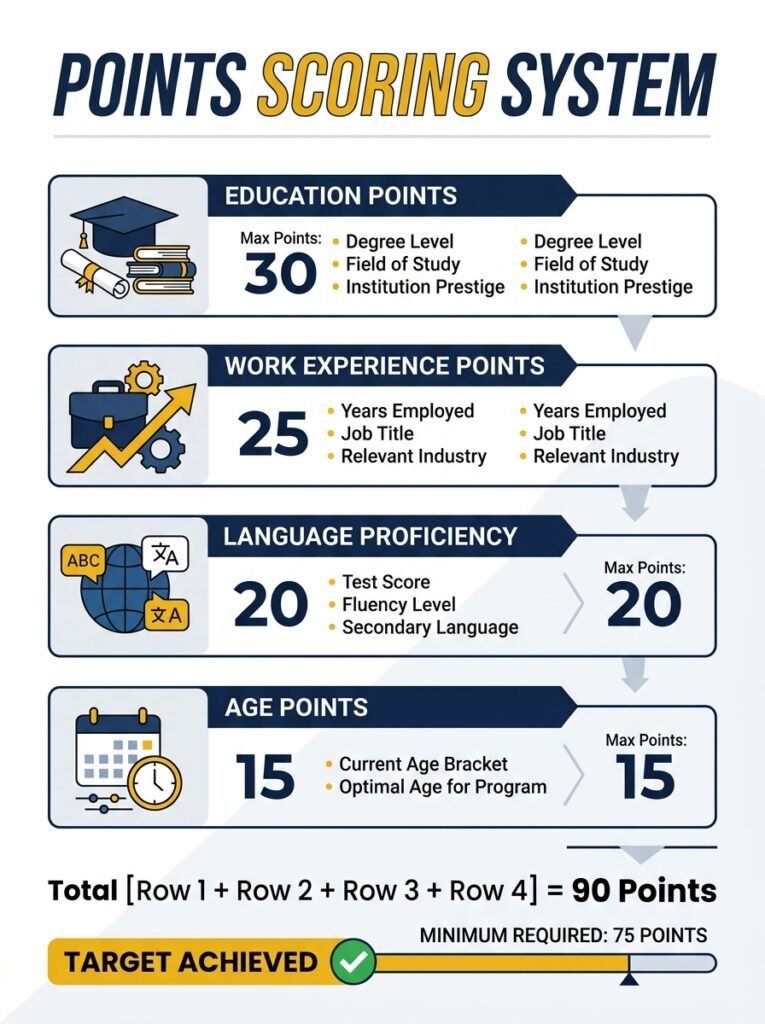
Here is how points are awarded under the points route. You need six or more to qualify. The values below reflect the criteria widely reported across 2026 immigration sources; treat them as a planning guide and verify against the official calculator.
| Criterion | Points |
|---|---|
| Partial recognition of your qualification | 4 |
| Qualification in a shortage occupation (Mangelberufe) | 1 |
| Work experience — at least 2 years (in last 5 years) | 2 |
| Work experience — at least 5 years (in last 7 years) | 3 |
| German language — A2 | 1 |
| German language — B1 | 2 |
| German language — B2 or higher | 3 |
| English — C1 or native (on top of baseline) | 1 |
| Age — under 35 | 2 |
| Age — 35 to 40 | 1 |
| Previous legal stay in Germany (6+ consecutive months) | 1 |
| Accompanying spouse/partner also meets Opportunity Card criteria | 1 |
A few realities worth internalising. Work-experience points and the higher-experience points do not stack — you claim one experience band, not both. Age points disappear entirely at 41, so older applicants must build their six points from qualification, experience, and language. And the single biggest lever for most people is German: going from A1 to B1 or B2 can add two or three points on its own. English at B2 satisfies the baseline but earns zero points; only C1 or native English adds one.
A typical profile that clears the bar easily: a university graduate under 35 with partial recognition (4) + two years’ relevant experience (2) already reaches six before any language bonus.
ANABIN and degree recognition — the step people fail on
Whether you go Direct or Points, everything hinges on how Germany views your qualification, and that is decided by the ANABIN database (anabin.kmk.org). Check your university and your specific degree there. An H+ or H++ rating means your degree is treated as automatically comparable, which can put you on the Direct Route. If your institution or programme is not clearly listed, you may need a Statement of Comparability (Zeugnisbewertung) from the ZAB (Central Office for Foreign Education), or a preliminary recognition check for regulated professions.
Skipping this step is the most common reason applications stall. Do it before you book anything else, because the answer determines which route you are even eligible for.
The financial requirement
You must prove you can support yourself during the job search. For 2026 the benchmark is at least €1,091 per month, which works out to about €13,092 for the full year. This is commonly shown via a blocked account (Sperrkonto), though some consulates accept alternatives such as a formal declaration of commitment or a pre-arranged part-time contract. One practical trap: if you already have a blocked account set up at the lower student rate, you will likely need to top it up, because the Opportunity Card benchmark is higher than the student monthly figure. Requirements vary by consulate, so confirm what yours accepts.
How the EU Blue Card fits in — and the new 2026 salary numbers
The Opportunity Card is a bridge, not the destination. Once you receive a qualifying job offer, you typically convert your status — often to an EU Blue Card, Germany’s flagship work visa for university-educated professionals. This is where salary thresholds matter, and they were raised on 1 January 2026.
For 2026, the standard EU Blue Card salary threshold is €50,700 gross per year (about €4,225 per month). A reduced threshold of €45,934.20 gross per year (about €3,827 per month) applies to shortage occupations, recent graduates, and qualifying IT specialists. These figures represent roughly a 5% increase over 2025, because Germany recalculates them each year from a fixed formula tied to its pension contribution ceiling.
Why care about this while you still hold the Opportunity Card? Because knowing the exact threshold your offer must clear gives you leverage in interviews and salary talks. Candidates who name the number — and cite the correct shortage-occupation category if it applies — negotiate from a stronger position than those who discover a shortfall late. Reported Blue Card figures vary across websites, so always confirm the current threshold with BAMF or Make-it-in-Germany before assuming.
How to apply — step by step
- Check recognition first. Look up your degree on ANABIN and decide whether you are Direct Route or Points Route.
- Score yourself honestly. If you are on the points route, tally your points and close any gap (usually via German language) before applying.
- Sort your finances. Open or top up a blocked account, or arrange the funds proof your consulate accepts (about €1,091/month).
- Gather documents. Passport, degree and recognition documents, language certificates, experience letters, CV, proof of funds, and any shortage-occupation evidence.
- Book the appointment. Apply at the German embassy or consulate serving your country and attend the biometric appointment. The visa fee is commonly around €75.
- Wait for the decision. Processing typically takes about 2–3 months, though this varies by mission and season.
- After arrival. Register your address (Anmeldung) within two weeks, then job-hunt, use trial employment, and convert to a work permit or Blue Card once you sign a contract. Conversion fees run roughly €56–€100 depending on the federal state.
Watch out for scams and bad advice
Immigration demand attracts fraud, so protect yourself:
- No one can “guarantee” a card or a job. The Chancenkarte is a job-search permit, not a job — anyone promising guaranteed employment is a red flag.
- Use official tools. Verify recognition on ANABIN and eligibility on the official Make-it-in-Germany self-check, not on a random agent’s word.
- Beware outdated numbers. Salary thresholds and financial rules change yearly; a post quoting 2024 figures may steer you wrong.
- Keep money official. Pay the visa fee through official channels only, and be wary of anyone demanding large cash sums for “processing.”
Who this route does not suit
- Applicants without a recognized degree or 2+ years of vocational training — you will not meet the baseline.
- People who cannot prove the ~€1,091/month funds for the full stay.
- Those who cannot reach 6 points and lack full recognition — often older applicants with no German and limited experience.
- Anyone who needs guaranteed income immediately — this is a job-search window of months, with only part-time work allowed, not a guaranteed salary from day one.
Being honest with yourself here protects your time and money.
Key Takeaways
- The Germany Opportunity Card 2026 (Chancenkarte) is a 12-month, points-based residence permit to job-search without a prior offer.
- Qualify via the Direct Route (fully recognized degree) or the Points Route (minimum 6 points).
- Baseline: 2+ years training or a recognized degree, German A1 or English B2, and about €1,091/month in funds.
- You may work part-time up to 20 hours/week and take 2-week trials while searching.
- You usually convert to an EU Blue Card on a job offer — 2026 thresholds are €50,700 standard / €45,934.20 reduced.
- Check ANABIN first, and verify every figure on official German sources before applying.
FAQ
Q1: What is the Germany Opportunity Card (Chancenkarte)? It is a points-based residence permit introduced in June 2024 that lets skilled non-EU workers live in Germany for up to 12 months and search for a qualified job without a prior offer. Holders can work part-time and take short trial jobs while searching.
Q2: How many points do I need for the Opportunity Card in 2026? You need at least 6 points on the points system — unless your qualification is fully recognized in Germany, in which case you use the Direct Route and no points are required. Points come from recognition, experience, language, age, and prior ties to Germany.
Q3: How much money do I need to show for the Opportunity Card? For 2026, you must prove roughly €1,091 per month (about €13,092 per year), commonly through a blocked account. If you already hold a student-rate blocked account, you will likely need to top it up to meet the higher benchmark.