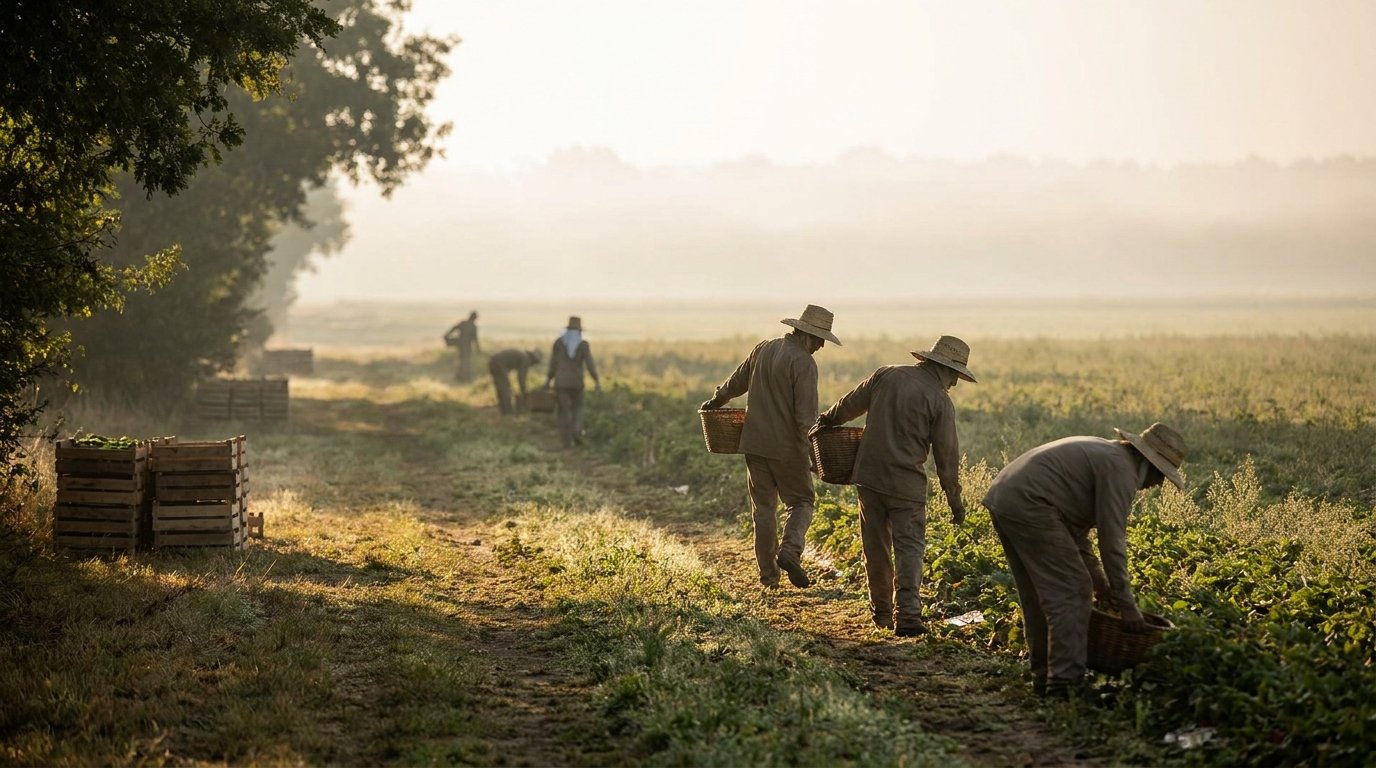
Every year, several hundred thousand people cross borders legally to plant, tend and harvest someone else’s crops. It is one of the few forms of work where a person with no degree, no professional licence and no capital can obtain a legal visa to a high-income country. That is precisely why it attracts more misinformation than almost any other category of migration.
The single most common mistake is treating “farm worker jobs abroad with visa sponsorship” as one thing. It isn’t. Agricultural labour schemes come in three fundamentally different shapes, and which shape you are looking at determines whether you are eligible before anything else about you matters — before your experience, your English, your references or your willingness to work hard. Understand the three, and you can evaluate any offer from any country in about five minutes.
The short answer
How do farm worker jobs abroad with visa sponsorship work? Agricultural work visas fall into three types: bilateral schemes open only to citizens of specific partner countries, employer-sponsored permits open to any nationality but requiring an approved employer, and youth mobility visas open by age rather than skill. Your nationality and age decide which are available to you.
The three kinds of farm work scheme
Type one: bilateral schemes. These are agreements signed between two governments — a destination country and a specific list of sending countries. Recruitment usually runs through a government office or an approved agency in the sending country, workers travel in organised cohorts, and the destination country handles a predictable number of arrivals each season. Several of the world’s largest and oldest agricultural programmes work this way, including the long-running seasonal arrangements in North America and the Pacific labour schemes serving Australasian growers.
The defining feature is that eligibility is a matter of citizenship. If your passport is not on the list, there is no application form, no queue, no exception and no fee that changes it. This is where most fraud happens: an agent sells a “seasonal agricultural visa” to someone from a country that has no such agreement, collects the money, and disappears. Before you engage with any offer, find out whether the scheme it names is bilateral, and whether your country is a partner.
Type two: employer-sponsored work permits. These are open to workers of any nationality, but they run through the employer rather than through a government-to-government agreement. Typically the employer must first prove they tried and failed to hire locally — a labour market test, under various names in various countries — then receive approval to hire from abroad, and only then can you apply for the visa attached to that specific job.
This is the route most readers will actually use. It is slower, more paperwork-heavy, and entirely dependent on finding a real employer willing to do the work. But it is not restricted by passport.
Type three: youth mobility and working holiday visas. A different logic altogether: these are reciprocal arrangements aimed at young people, usually capped between the ages of eighteen and thirty or thirty-five, and they grant broad permission to work rather than a specific job. Agricultural work is often the default employment because farms are the easiest employers to walk into. In several countries, completing a set number of days of regional farm work extends the visa for a second or third year.
The catch mirrors type one: these visas exist only between countries that have signed reciprocal agreements, and the annual quotas are frequently small and heavily oversubscribed.
Also Read: Factory Worker Jobs in Canada With Visa Sponsorship for Foreigners in 2026
Reading a scheme correctly before you commit
Once you know the three categories, four questions settle almost everything:
Is my nationality eligible at all? Check on the destination government’s own immigration website, not on a recruiter’s. If a scheme is bilateral, the partner country list is published — it is not a secret negotiated by agents.
Who initiates the paperwork? In nearly every employer-sponsored system, the employer applies for permission to hire and the worker applies for the visa afterwards. If someone offers to file the employer’s side of the application on your behalf, for a fee, treat that as a definitional red flag.
Is the permit tied to one employer? Most agricultural visas are. That has a serious practical consequence: if the job goes wrong, your legal status may go with it. Ask, before departure, what the process is for changing employers, and whether the destination country provides a protection route for workers in abusive situations. Many now do.
What is the maximum duration, and is it renewable? Seasonal schemes commonly run somewhere between six and nine months. Non-seasonal agricultural permits often run one to three years. The difference matters enormously for whether the trip is financially worth it after travel costs.
What the work actually pays — and what should come with it
Anyone quoting you a single global hourly rate is guessing. Wages are set nationally or regionally, and in most destination countries agricultural work must be paid at a legally defined minimum for that occupation and region. The right approach is not to memorise a number but to find the official figure: nearly every country with a formal scheme publishes a prevailing or minimum wage for agricultural occupations, and your contract must meet it.
Two adjustments matter more than the headline rate. The first is piece rates. In harvesting, pay is often calculated per unit picked rather than per hour, and in well-regulated systems the piece rate must still average out to at least the hourly minimum. Ask which system applies and what an average worker earns in a week — not what a fast worker earns on a good day.
The second is deductions. Housing, transport and equipment costs are frequently taken from wages, and in properly regulated schemes these deductions are capped by law. Get them in writing before you travel.
What a legitimate offer usually includes:
- Accommodation that meets a defined standard, sometimes inspected by the authorities, with any rent deduction capped
- Transport to and from the worksite, and in many seasonal schemes at least part of the international airfare
- Health cover for the period before you qualify for any public system
- A written contract stating hours, wage, duration and duties before you leave home
That last point is the quiet one. In fair recruitment standards used internationally, the worker should see and sign the contract in a language they understand before departure. An offer that promises to “sort out the paperwork on arrival” is a bad offer regardless of how good the money sounds.
The recruitment fee rule
Here is the principle that protects you more than any other, and it holds across almost every regulated destination: the cost of hiring you is the employer’s cost, not yours.
Government application fees for employer approval are legally the employer’s to pay in most systems, and in several they are explicitly prohibited from recovering that cost from the worker by any means, including wage deductions. Licensed recruiters in many sending countries are likewise barred from charging job seekers, or are capped at a small regulated amount. The international standard that most reputable growers and supermarkets now audit against is straightforward: workers pay no recruitment fees.
You will still pay for genuinely personal things — your passport, your visa application fee, your medical examination, sometimes your travel. Those are normal. A four-figure payment to “secure the position” is not.
Also Read: H-1B Extension Fee 2026: $4,000 Rule Starts Sept 9
How to find real openings
Skip the aggregators. The postings that fill search results are largely scraped, resold and months out of date, and many exist only to harvest your contact details.
Go instead to:
- The destination country’s official job portal. Most immigration systems require employers hiring from abroad to advertise domestically first, which means genuine openings are legally obliged to appear on public boards.
- The published list of approved sponsors. Countries running employer-sponsored schemes usually publish which employers hold a valid licence or approval. This list is a gift — it is a directory of companies that demonstrably hire foreign workers, and you can approach them directly.
- The growers’ associations. Regional producer bodies often maintain their own labour pages and know which members are short-staffed.
- Large operations’ own careers pages. Big greenhouse, dairy, poultry and packing companies recruit continuously and post directly.
When you search, use the occupational classification code rather than plain words. Almost every country classifies jobs with a numbered system, and searching by the agricultural codes surfaces postings that a keyword search for “farm work” never reaches.
Timing: think in harvest seasons, not calendar years
This is where experienced seasonal workers separate themselves from first-timers.
Recruitment for a harvest happens long before the harvest. Because the employer’s approval process can take weeks or months and the visa adds more time on top, the practical rule is to be in contact with employers three to five months before the season starts. For a northern-hemisphere spring and summer season, that means making contact in the autumn of the preceding year. Applying in March for April work is applying too late, and the people who got those jobs started talking to the farm in October.
The more sophisticated version of this is hemisphere-chaining. Because the northern and southern growing seasons are roughly six months apart, a worker with the right nationality profile can work a European or North American summer harvest and a southern-hemisphere one, though this requires two entirely separate visas and careful attention to the maximum stay rules on each.
How fraud works in this sector
Agricultural recruitment is targeted heavily by fraudsters because the demand is genuine, the applicants are often first-time migrants, and the process is unfamiliar enough that a fake version looks plausible.
The recurring patterns:
- Selling access to a bilateral scheme that the applicant’s country has no agreement with
- Fabricated approval numbers and forged official letters, sometimes using a real company’s name and logo without their knowledge
- Advance fees described as processing, placement or “visa guarantee” costs
- No interview at all — a formal-looking offer letter arrives after a single message
- Pressure and deadlines — the position will supposedly be given away within twenty-four hours
- Guarantees of permanent residence, which no employer and no agent has the authority to give
Verification takes one afternoon. Find the employer’s phone number on their own public website — never the number in the email — and call to confirm the vacancy and that they applied to hire from abroad. Cross-check the company against the destination country’s published sponsor or approved-employer list. Confirm any recruiter holds a licence in your own country, since most sending states regulate overseas employment agencies and publish the register.
And understand the stakes. Submitting a forged document to an immigration authority, even one you believed was genuine, is usually treated as misrepresentation. The typical consequence is a multi-year ban from the country — a far worse outcome than losing the fee.
Does farm work lead to permanent residence?
Sometimes, slowly, and never automatically.
Seasonal schemes are designed to be temporary and generally build no direct path to settlement, by intent. Non-seasonal agricultural permits are different: because they involve continuous employment, they can accumulate the work experience that regional and points-based settlement programmes ask for. Several countries have run dedicated agri-food settlement pathways, and these open, fill and close on their own schedules.
The honest summary is that farm work can be the first step of a longer route, but the route is neither quick nor guaranteed, and it depends on programmes that change frequently. Any offer that presents a harvest job as a purchase of permanent residence is describing something that does not exist.
Key Takeaways
- Identify the scheme type first — bilateral, employer-sponsored, or youth mobility. It decides your eligibility before anything else does.
- If a scheme is bilateral and your country isn’t a partner, no fee, agent or application changes that.
- You don’t pay to be hired. Employer-side costs are the employer’s, and reputable systems ban passing them to workers.
- Judge an offer by its contract, housing terms and deduction caps, not by the headline wage.
- Make contact three to five months before the season, not when it starts.
- Verify the employer through official channels before sending money or documents. A misrepresentation finding costs years.
Rules, quotas and wage floors in this sector change every year and sometimes mid-season. Treat this article as a framework for evaluating opportunities, and confirm current requirements on the destination government’s official immigration website before you act.
FAQ
Do I need farming experience to get a job abroad?
For seasonal harvest work, usually not — employers expect to train you, and the real requirements are physical stamina and reliability. For year-round roles involving livestock, machinery or greenhouse systems, documented experience makes a large difference and is often required.
Can I apply for the work visa myself?
You apply for your own visa, but in employer-sponsored systems you cannot file the employer’s approval application — only the employer can. Anyone offering to do that step for you, for a fee, is misrepresenting the process.
Is accommodation always free?
No. Many schemes require the employer to provide or arrange housing, but a rent deduction is often permitted. In well-regulated systems that deduction is capped, and the cap should appear in your contract.
How long does the whole process take?
Plan for three to six months from first contact to arrival. The employer’s approval stage is usually the longest, and the visa adds several weeks after that.
Can I change employers once I arrive?
Frequently not, or not easily — most agricultural visas are tied to a named employer. Ask before departure what the transfer process is, and what protection exists if the workplace turns out to be unsafe.
Is there an age limit?
Only on youth mobility and working holiday visas, which typically cap at thirty or thirty-five. Bilateral and employer-sponsored schemes usually have a minimum age of eighteen and no upper limit, though physically demanding roles have practical limits.