
Germany Opportunity Card 2026: Move to Germany Before You Even Have a Job
Here is the part most people miss: you do not need a German job offer to legally move to Germany in 2026. Through the Germany Opportunity Card — the Chancenkarte — qualified non-EU workers can relocate first, then search for a job from inside the country for up to a year. For anyone tired of applying to overseas employers and waiting months for a sponsorship that never comes, this flips the whole process around.
The Opportunity Card is not a rumor or a “coming soon” program. It became active on 1 June 2024 under Section 20a of Germany’s Residence Act, as part of the country’s reformed Skilled Immigration Act. If you have read older articles claiming it is still being planned, those are out of date. In 2026 it is one of the most flexible legal routes into Europe’s largest economy.
This guide breaks down exactly who qualifies, how the points system works, what it costs, and how to apply — in plain language.
Key takeaways
- The Opportunity Card gives qualified non-EU workers up to 12 months in Germany to find a job — no prior offer required.
- You qualify either as a recognized skilled worker (no points needed) or through a points system (minimum 6 points).
- For 2026, you generally need to prove roughly €1,091 per month in living funds (about €13,092 for the year).
- You can work part-time up to 20 hours a week while you search, and do short trial jobs with employers.
- The visa fee is around €75, and once you land a qualifying job you can switch to a long-term work permit or EU Blue Card.
Also Read: Germany skilled worker jobs 2026
What exactly is the Germany Opportunity Card?
The Opportunity Card is a one-year residence permit built for skilled professionals from outside the EU and EEA who want to look for work inside Germany rather than from abroad. According to Germany’s official immigration guidance, it is regulated under Section 20a of the Residence Act and was designed to fix a very real problem: Germany simply does not have enough skilled workers.
Think of the difference this way. The EU Blue Card is for people who already hold a job offer that meets a salary threshold. The Opportunity Card is for people who do not have an offer yet — it buys you time and legal status to attend interviews, meet employers in person, and prove yourself on the ground. Many applicants treat it as a stepping stone: arrive on the Chancenkarte, find the right role, then upgrade to a Blue Card or standard work permit.
Why is Germany doing this? Reporting from German labor sources points to a structural, not temporary, shortage. The Federal Employment Agency has flagged gaps across more than 160 occupations, and surveys cited by immigration advisers show a large share of German businesses struggling to fill skilled roles. An aging population and a housing shortfall reported at around 1.4 million homes mean the demand for nurses, tradespeople, builders, logistics staff, engineers and IT workers is not going away.
Also Read: EU Blue Card Germany guide
Who is eligible in 2026? The two routes
There are two separate doors into the Opportunity Card, and you only need to walk through one.
Route 1 — Recognized skilled worker (no points needed). If your foreign university degree or vocational qualification is fully recognized in Germany, or you completed your studies or training in Germany, you are treated as a recognized skilled worker. You skip the points system entirely. You can check whether your credential is recognized using Germany’s official Anabin database or the “Make it in Germany” self-check tool before you apply.
Route 2 — The points system (minimum 6 points). If your qualification is only partly recognized, you can still qualify by collecting at least six points. Points are awarded for a mix of factors, including:
- Your qualification and whether it is partially recognized
- Work experience in your field
- Language ability — German and/or English
- Age (younger applicants score more)
- A prior connection to Germany, such as previous residence
For the points route, you generally need at least German A1 or English B2 language proficiency. The direct skilled-worker route has no language minimum, although stronger German will always help you actually land a job once you arrive.
How the points system works (in simple terms)
The six-point threshold sounds strict, but it is reachable for many mid-career professionals. The system rewards exactly the things employers value: recognized skills, real experience, useful language ability, and a realistic age for long-term work. Importantly, immigration sources note that your point total is not printed on the card — once you are in, every holder has the same rights regardless of how many points they scored. The points are simply the entry test.

A practical tip: improving your German from beginner to intermediate, or documenting a few more years of verified experience, is often the cheapest way to cross the line if you are sitting at four or five points.
Also Read: Free German language resources for job seekers
Money: what you must prove for 2026
You have to show you can support yourself for the full stay without relying on public funds. For 2026, the widely referenced figure is about €1,091 per month, which works out to roughly €13,092 for twelve months. (Some official references quote a slightly lower benchmark tied to current rates, so always confirm the exact amount with the German mission handling your case.)
You can usually prove these funds in one of three ways:
- A blocked account (Sperrkonto) with a recognized provider — the most common method.
- A declaration of commitment (Verpflichtungserklärung) from someone in Germany who agrees to support you.
- A part-time job contract in Germany covering your living costs.
Here is a detail that genuinely helps: Germany’s minimum wage rose to €13.90 per hour on 1 January 2026. At the maximum 20 hours per week allowed under the Opportunity Card, that comes to roughly €1,112 a month — which on its own slightly exceeds the monthly threshold. So once you secure even part-time work after arriving, you can often sustain yourself legally while you keep hunting for a full-time role.
What you’re allowed to do on the card
The Opportunity Card is built for an active job search, and it gives you room to work while you look:
- Part-time work up to 20 hours per week in any sector during the search period.
- Trial employment (Probearbeit) of up to two weeks per employer — and there is no cap on how many trials you do. This lets you sample multiple workplaces and show employers what you can do before anyone commits.
What it does not do is hand you a permanent job or automatic residency. It is a search permit. The real goal is to convert it into a long-term status once you are hired.
Which jobs and sectors are realistic?
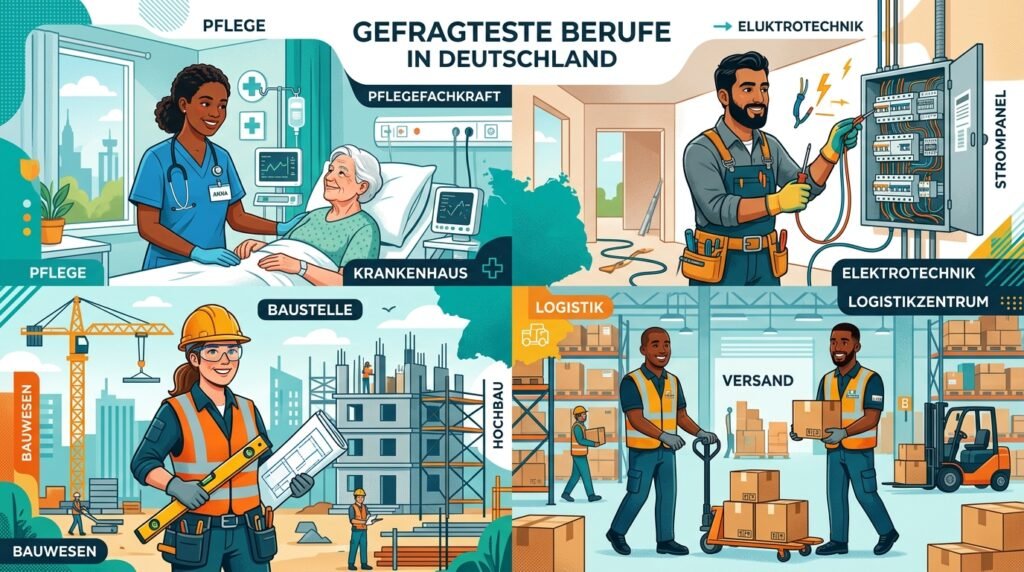
A common myth — especially among applicants from South Asia — is that Germany only wants IT specialists. That is not true. The shortage spans hands-on and vocational roles just as much as tech. Sectors with genuine demand and Opportunity-Card relevance include:
- Healthcare and elderly care — nurses, caregivers, physiotherapy and medical support staff
- Skilled trades — electricians, plumbers, mechanics, technicians
- Construction — driven by Germany’s large housing shortfall
- Logistics and warehousing — Germany is a European logistics hub
- Hospitality and services — a sector that lost workers and is still rebuilding
- IT, engineering and manufacturing — the traditional high-skill demand
If your background is in any of these, your odds of converting the card into a real job are meaningfully better.
Also Read: highest paying jobs in Germany for foreigners
How to apply: step by step
The process is document-driven, and German consulates are strict about credential recognition and financial proof. A clean, complete file is everything.
- Check your recognition first. Use Anabin or the “Make it in Germany” self-check to confirm whether your qualification is fully or partially recognized. This decides which route you are on. Do not skip it.
- Calculate your points if you are on the points route, and make sure you reach at least six — every claim must be backed by documents, not self-declared.
- Arrange your financial proof — open a blocked account or secure a declaration of commitment for the required amount.
- Apply online through Germany’s Consular Services Portal (the Federal Foreign Office’s official portal), or follow your local German embassy/consulate’s instructions if online processing is not offered in your country.
- Book and attend your appointment — typically biometrics and document verification, often via a visa service center such as VFS Global, depending on your country.
- Wait for processing. Timelines vary by mission; many applicants report roughly 6 to 12 weeks, though some consulates take longer. Apply early.
The standard visa fee is about €75, but budget realistically for the blocked account, health insurance, flights and your first months of living costs.
A note for some nationalities: citizens of countries such as the United States, United Kingdom, Canada, Australia, New Zealand, Japan, South Korea and Israel can usually enter Germany visa-free and then apply for the Opportunity Card at the local foreigners’ office (Ausländerbehörde) after arrival.
After you find a job: the path to staying
Landing a role is where the Opportunity Card pays off. Once you have a qualifying offer, you switch — at your local Ausländerbehörde — to either an EU Blue Card or a standard skilled-worker permit.
For 2026, the EU Blue Card salary thresholds referenced by immigration advisers are around €50,700 for standard occupations and about €45,934.20 for shortage occupations and recent graduates. Blue Card holders can reach permanent residence relatively quickly — commonly after 33 months, or as little as 21 months with German at B1 level. If you have a job offer but cannot switch immediately (for example, recognition is still pending), a follow-up Opportunity Card can extend your total stay up to two years while you finish the process.
Is the Opportunity Card worth it in 2026?
For most qualified non-EU professionals, yes. It removes the single biggest barrier — needing an employer to sponsor you before you have even met them — and replaces it with a fair, transparent, points-based path. You still have to do the work: get your credentials recognized, prove your funds, and actually find a job once you are there. But few legal routes into Western Europe are this open right now.
If you are weighing your options for working abroad in 2026, the Chancenkarte deserves a serious look — especially if your skills sit in healthcare, the trades, construction, logistics, engineering or IT.
Also Read: countries with easiest work visa 2026
Summary
The Germany Opportunity Card 2026 lets skilled non-EU workers move to Germany for up to a year to find a job without a prior offer. Qualify as a recognized skilled worker or score six points, prove around €1,091 a month in funds, pay roughly €75, and you can work part-time while you search. Land a qualifying role and you can convert to a Blue Card or work permit on the path to permanent residence. Always confirm the latest figures and document requirements with your responsible German mission before you apply.
7. FAQ Section
-
Do I need a job offer for the Germany Opportunity Card?
No. The Opportunity Card is specifically for people who do not yet have a job offer. It gives you up to 12 months in Germany to search for qualified work and attend interviews in person.
-
How many points do I need for the Opportunity Card in 2026?
If your qualification is fully recognized in Germany, you need zero points — you qualify directly. If it is only partially recognized, you need at least six points from factors like work experience, language, age and qualification.
-
How much money do I need to show?
For 2026, the commonly referenced amount is about €1,091 per month, or roughly €13,092 for the year, usually proven through a blocked account, a declaration of commitment, or a qualifying part-time job. Confirm the exact figure with your German consulate.
-
Can I work on the Opportunity Card?
Yes — up to 20 hours per week part-time during your job search, plus trial employment of up to two weeks per employer. Full-time work begins once you switch to a work permit or EU Blue Card.
-
How much does it cost and how long does it take?
The visa fee is around €75. Processing times vary by consulate, but many applicants report roughly 6 to 12 weeks. Apply early and keep your documents complete.
-
Does the Opportunity Card lead to permanent residency?
Not directly. Once you find a qualifying job, you switch to an EU Blue Card or work permit, which can lead to permanent residence — sometimes in under three years with good German language skills.