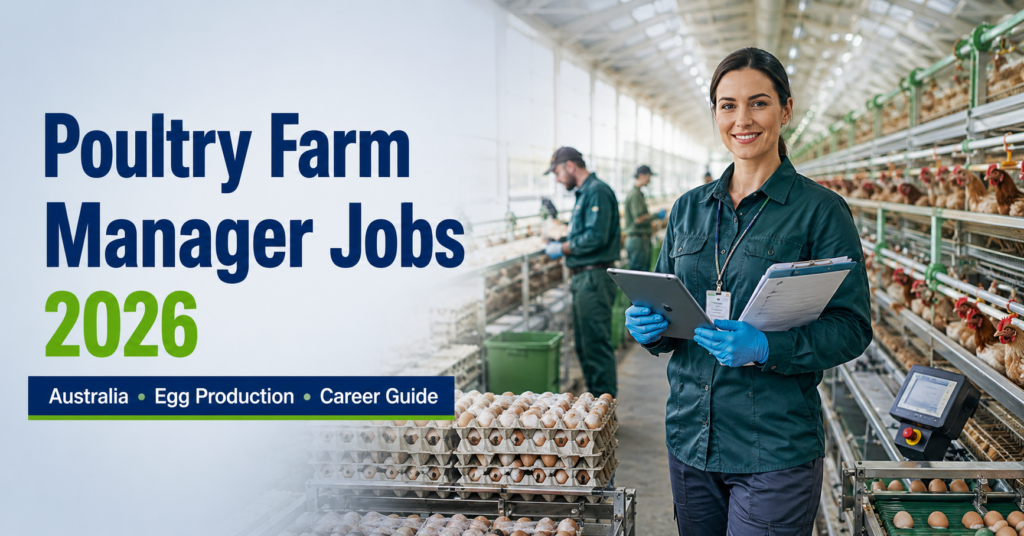
Australia’s egg and poultry sector is one of the country’s most stable agricultural industries, and experienced farm managers remain in steady demand heading into 2026. Several commercial egg-production roles — particularly around the Newcastle region of New South Wales — have advertised salaries in the range of AUD 78,000–85,000 per year, with some employers open to visa sponsorship for suitably qualified overseas applicants. This guide explains what the role actually involves, realistic pay, the visa pathways that apply, and how to apply without falling for the “guaranteed visa” scams that are common in this niche.
What does a poultry farm manager do?
A poultry farm manager runs the day-to-day operation of a commercial layer (egg) or broiler (meat) farm. The job is hands-on and accountability-heavy rather than purely administrative. Typical responsibilities include:
- Managing flock health, welfare and performance, and coordinating with veterinarians when needed
- Overseeing feeding, watering, egg collection, grading, storage and quality control
- Maintaining strict biosecurity, animal-welfare, and workplace health-and-safety standards
- Supervising and rostering farm staff, including weekend and after-hours cover
- Production planning, budgeting, record-keeping and performance reporting
Poultry farm manager salary in Australia (2026)
Pay varies widely with the size of the operation, your experience, and the state. Based on current Australian job listings, indicative ranges are:
| Role level | Typical annual salary (AUD) |
|---|---|
| Poultry / farm worker (entry) | $45,000 – $60,000 |
| Supervisor / 2IC | $60,000 – $75,000 |
| Poultry farm manager | $78,000 – $95,000+ |
Larger operations and roles requiring 5+ years of experience or formal qualifications tend to sit at the higher end. Overtime, on-call duties and accommodation support can add to the package on some farms.
Visa pathways and sponsorship
In Australia’s skilled migration system, “Poultry Farmer” sits under ANZSCO code 121321. That classification can open several routes, depending on your skills assessment, experience and which state nominates you:
- Employer-sponsored (subclass 482, Skills in Demand / TSS): a temporary route where an approved Australian employer sponsors you for a role they can’t fill locally.
- State/territory nominated (subclass 190 and 491): permanent or provisional regional pathways; some states (for example Tasmania and South Australia) have included poultry/agriculture occupations under their nomination programs.
- Employer-sponsored permanent (subclass 186 or 494): longer-term options for eligible, experienced candidates.
Eligibility, occupation lists and salary thresholds change regularly, so always confirm the current rules on the official Department of Home Affairs website (immi.homeaffairs.gov.au) before you spend money on any application.
Eligibility and skills
Most employers and visa streams will expect some combination of:
- Proven experience in poultry, layer or broiler operations (entry roles may offer on-the-job training)
- A relevant qualification — a certificate, diploma or degree in agriculture, animal science or poultry production is an advantage
- Knowledge of farm-management software, biosecurity and animal-welfare codes
- Competent English (skilled visas usually require an IELTS/PTE result; check the level for your specific stream)
- A valid driver’s licence, as many farms are in regional areas
The biosecurity rule most applicants miss
Australian poultry farms enforce strict biosecurity. Many employers require that staff do not own or keep any birds (chickens, ducks, pet birds) at home, and some extend this to anyone you live with. This is non-negotiable on a lot of farms, so factor it in before applying.
How to apply (the safe way)
- Use reputable Australian job platforms such as SEEK, Indeed Australia, Jora, Adzuna or the government’s Workforce Australia site.
- Search the exact role — for example “poultry farm manager visa sponsorship” — and filter by state.
- Create a professional profile and upload a tailored CV plus a short cover letter that highlights flock-management experience.
- Read each listing carefully to confirm whether sponsorship is genuinely offered, then apply directly through the employer or platform.
- If you receive an offer, verify the company exists and is a registered sponsor before signing anything.
Watch out for visa scams
This is a niche where job seekers are frequently targeted. Protect yourself:
- No agency or website can “guarantee” you an Australian work visa. Approval is decided only by the Department of Home Affairs.
- A legitimate employer will not ask you to pay them for a job offer or sponsorship.
- Be cautious of listings with no company details, only a WhatsApp number, or pressure to pay quickly.
Frequently asked questions
Can I get a poultry farm job in Australia without experience?
Entry-level farm-worker roles sometimes provide training, but the manager role almost always requires prior poultry or livestock experience.
Is IELTS required?
For employer-sponsored and skilled visas you will usually need an English test result. The required score depends on the visa subclass, so check your specific stream.
Which states have the most poultry roles?
New South Wales, Queensland, Victoria and South Australia regularly list poultry and egg-production roles, often in regional towns.
Disclaimer: This article is a general guide based on publicly available job listings and official information current at the time of writing. Visa rules, occupation lists and salaries change — always verify the latest requirements on the official Department of Home Affairs website before applying or paying any fees.