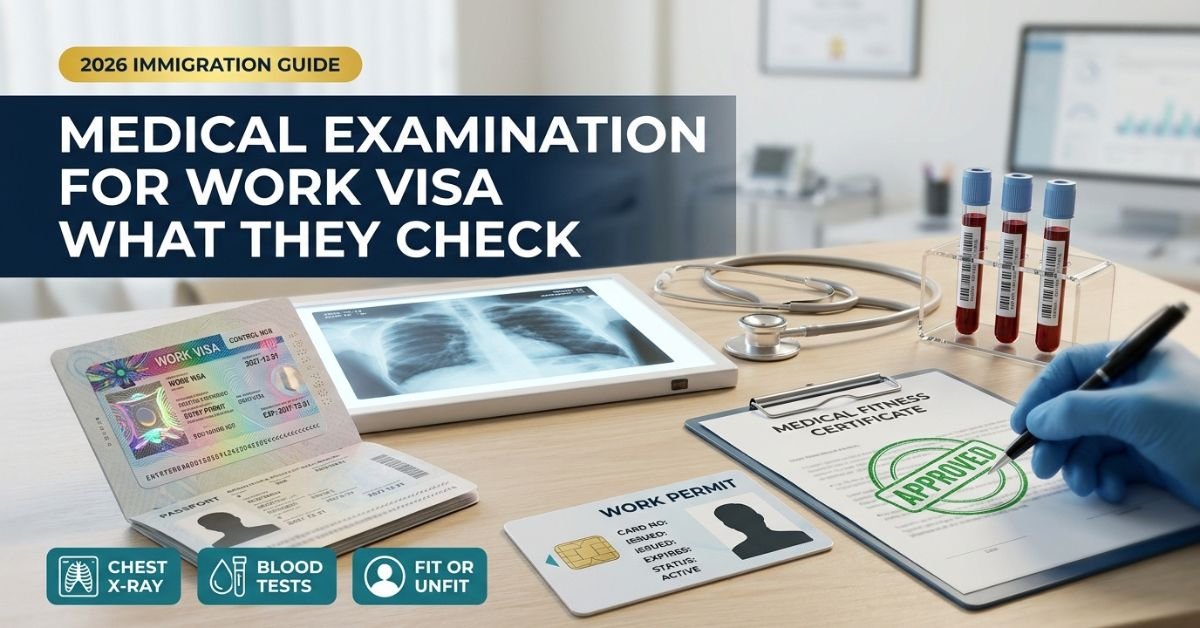
Medical Examination For Work Visa: What They Check And What Fails You
A medical examination for work visa approval is really answering three questions:
- Could you spread a serious infection?
- Is any long-term illness you have under control?
- Are you the person your documents say you are?
Clear all three and the medical tends to be the easiest box on the whole application. Stumble on one, and a signed job offer can sit frozen for months.
What trips people up is the assumption that every country runs the same test. They don’t. Three people from three continents can face very different checklists on the same day:
- a nurse from Manila bound for Riyadh
- a software engineer from Lagos moving to Toronto
- a chef from Buenos Aires heading to Auckland
Each also faces different rules on old lung scars and a different deadline before the certificate goes stale.
Here are the 13 things that matter most. The first seven are what examiners check. The final six are where applications actually fall apart.
Medical Examination For Work Visa: The Quick Answer
Quick answer: Most work visa medicals combine a health questionnaire, a physical exam, a chest X-ray for tuberculosis and, in many countries, blood tests for HIV, hepatitis and syphilis. Applicants usually fail because of an active infection, a poorly controlled chronic illness, X-ray findings the destination won’t accept, or mismatched paperwork.
Key Takeaways
☐ No two destinations use an identical checklist, so always start with your own country’s requirement.
☐ Tuberculosis screening is the one element almost every system shares.
☐ Gulf states run some of the strictest panels, and several positive results there end an application outright.
☐ Canada, Australia and New Zealand also consider how much your condition could cost their public health systems.
☐ A healed lung scar can be acceptable in one country and disqualifying in another.
☐ Certificates expire, sometimes within weeks, so timing is part of passing.
☐ Honesty about your history protects you; concealment rarely does.
Who Actually Needs One (And Who Usually Doesn’t)
| Destination | What Work Applicants Commonly Face | Who Does It | Typical Validity |
|---|---|---|---|
| Gulf states (Saudi Arabia, UAE, Qatar, Kuwait, Oman, Bahrain) | A full pre-departure medical for workers from many countries, often followed by another check after arrival | Accredited medical centres assigned through the official screening system | Short, often around two months |
| United Kingdom | A tuberculosis test for longer stays if you’ve recently lived in a country on the UK’s TB list | Clinics approved by the UK government | 6 months |
| Canada | A full immigration medical, depending on where you’ve lived and the kind of work you’ll do | Government-approved panel physicians | 12 months |
| Australia and New Zealand | Health checks set by the application, common for longer stays, higher-TB regions and health or childcare jobs | Approved panel doctors and radiologists | Usually 12 months for Australia; New Zealand may accept a recent earlier exam |
| United States (temporary work visas) | Usually no routine immigration medical; the full exam is for permanent residence | Approved physicians (green card cases) | Not applicable for most work visas |
| Singapore and Malaysia | Medical screening for many work-permit holders, typically including TB and blood tests | Registered or designated clinics | Set by the issuing authority |
| Much of Europe | Often no immigration medical for standard work permits, though health insurance proof is common | Varies by country | Varies |
The takeaway is simple. Check what your destination asks for before you book anything, because booking the wrong exam wastes both money and time.
The Health Questionnaire You Sign
The questionnaire usually comes first and feels like a formality. It isn’t. You’ll be asked about past illnesses and operations, hospital admissions and the medicines you take. You’ll also be asked about any history of tuberculosis, including whether someone you lived with had it.
Examiners treat your answers as the baseline. If the X-ray shows something your form never mentioned, the gap itself raises questions. The same finding with a clear explanation and documentation behind it often raises very few.
- Records of any past TB treatment, including proof it was completed
- Hospital discharge letters
- A list of current medicines and doses
- A recent letter from any specialist who manages a long-term condition
The Physical Examination
Expect the familiar basics:
- height, weight, pulse and blood pressure
- a stethoscope on your chest and back
- a look at your skin, lymph glands, abdomen and limbs
Some systems check eyesight and hearing, particularly when the job involves driving, operating machinery or working at height.
Nerves push blood pressure up, and a high reading on the day can prompt a recheck. Sitting quietly for a few minutes before you’re called in genuinely helps. In most mainstream immigration systems the exam is respectful and non-invasive, and intimate examinations are generally not part of the process.
The Chest X-Ray For Tuberculosis
Tuberculosis travels quietly and spreads through the air, which is why nearly every immigration system screens for it. Adults and older children usually have a standard chest X-ray. Younger children often get a different screening approach unless there’s a specific concern.
The UK’s visa-side health check for most workers is built almost entirely around this image. Canada, Australia, New Zealand, the Gulf states and many Asian destinations also treat the X-ray as a core requirement.
When the film shows something unclear, applicants are usually asked for sputum samples. These are cultured in a lab and can add several weeks to the timeline. If you are pregnant, say so when booking. Most systems offer a way to delay the X-ray or add extra shielding.
Blood Tests For Infectious Disease
Gulf-bound workers typically face a wide blood panel, which may include:
- HIV
- hepatitis B and hepatitis C
- syphilis
- depending on the destination and the applicant’s background, malaria and other tropical infections
Canada usually tests adult applicants for HIV and syphilis and adds hepatitis tests only when a risk factor appears. Australia commonly asks for HIV testing for permanent visas and for applicants who’ll work in healthcare. It may request hepatitis screening for certain groups. Southeast Asian work-permit schemes often include HIV and TB checks as standard.
The lesson: don’t rely on a friend’s experience from a different country. Their list may look nothing like yours.
Blood Sugar, Blood Count And Kidney Checks
Many systems look at blood sugar, a full blood count and kidney function, sometimes through a blood marker and sometimes through a urine test. A single borderline result rarely sinks anyone.
These readings feed directly into the most common non-infectious reason for failure, covered in item 10. An examiner deciding whether diabetes, anaemia or kidney disease is “stable” relies on exactly these figures.
Urine, Stool And Pregnancy-Related Steps
Urine tests pick up protein, sugar and blood, which can point to kidney disease or unmanaged diabetes. Some Gulf and Asian destinations also ask for a stool sample to screen for intestinal parasites, which matters for jobs in food handling and domestic work.
Pregnancy rules differ sharply around the world. Some systems simply adjust the X-ray. A few employer-sponsored schemes may treat pregnancy as a reason to pause or reconsider an application, particularly for certain job types. If this applies to you, ask the clinic and your employer before paying any fees.
A Brief Mental Health Check
Some systems include a brief mental status assessment, and others simply ask questions on the form. Examiners are looking for serious, unmanaged conditions that could affect your safety or other people’s. They are not looking for ordinary anxiety about an important appointment.
A well-managed condition with a supportive letter from your doctor is viewed very differently from one that surfaces without explanation.
Infection Results That Can Mark You Unfit
Gulf screening systems generally treat these as disqualifying:
A positive HIV result
Active hepatitis B infection
Hepatitis C markers
Active tuberculosis
Certain tropical infections, such as malaria
One situation deserves particular attention. The common screening test for hepatitis C looks for antibodies, and antibodies often stay detectable long after a person has been successfully treated and cured. If that’s your history, bring treatment records and confirmation that the virus is no longer present. Ask the clinic in advance how your result will be interpreted.
Canada, Australia and New Zealand typically weigh conditions like HIV or hepatitis on their individual merits. Treatment, stability and expected care needs count, rather than the diagnosis alone.
Old TB Scars On Your Chest X-Ray
Verdict: nothing shows the gap between countries more clearly than this.
Suppose two people have the same faint scar from an infection treated ten years ago. The outcome depends on where they’re going:
- Gulf: screening is known for treating evidence of past TB very strictly. Scarring alone can be enough to produce an unfit result.
- Canada: it takes a middle path. Inactive TB can still lead to approval, often with a requirement to check in with local health authorities after arrival.
- UK: the certificate hinges on whether you’re free of infectious TB. Further tests can confirm that an old scar poses no risk.
So if you ever had TB, your destination matters enormously. Learn its approach before you choose where to apply.
Uncontrolled Blood Pressure, Diabetes And Organ Disease
Many workers live perfectly well with high blood pressure or diabetes, and plenty of them pass their medicals. The problems start when readings on exam day suggest the condition isn’t being managed. Serious heart, liver or kidney failure, active cancer, and physical limitations that prevent someone doing the job they were hired for can also lead to rejection, especially in employer-driven systems.
The most important advice is also the simplest. Keep taking your medication exactly as prescribed. Skipping a dose to “look healthier” usually does the opposite.
The Cost-Of-Care Test
Canada, Australia and New Zealand ask a question many applicants don’t expect. Beyond infection risk, would your care place a heavy burden on the public health system?
Canada sets a yearly cost threshold. Officers compare it with the projected cost of treating a condition over several years, and the government revises the figure regularly. Australia and New Zealand apply their own versions of the same idea.
These systems usually give applicants a chance to respond before refusing. That response might include a specialist’s report, a cheaper treatment plan or evidence of private coverage. Some family and humanitarian categories are exempt from the cost test, but most work applicants are not.
Paperwork Mistakes That Fail Perfectly Healthy People
| ❌ The Mistake | ✅ What To Do Instead |
|---|---|
| Using a local lab or your own doctor for the X-ray | Book only with a clinic approved for your destination |
| A misspelled name or wrong passport number on the booking | Ask the clinic to correct it officially before the exam |
| Missing the appointment window on your booking | Attend promptly; many booking slips expire quickly |
| Taking the medical months too early | Time it so the certificate is still valid when the visa is issued |
| Paying someone who promises a “guaranteed fit” report | Avoid it; results are recorded in official systems and fraud can end your application permanently |
Hiding Your Medical History
Doctors who do these exams every day notice surgical scars, injection sites and X-ray changes that don’t match a spotless questionnaire. In several countries, knowingly leaving out information counts as misrepresentation. That can lead to refusal plus a ban on applying again for years.
Being upfront, with records in hand, gives the examiner context and gives you the best chance of a fair decision.
Do And Don’t Before Exam Day
| ✅ Do | ❌ Don’t |
|---|---|
| Follow the clinic’s fasting instructions if blood sugar is being tested | Assume fasting rules are the same everywhere |
| Bring your original passport, national ID and booking confirmation | Turn up with photocopies only |
| Take regular medication as usual | Stop pills to influence the results |
| Mention pregnancy when you book | Wait until you’re standing at the X-ray machine |
| Set aside a full morning or longer | Schedule the exam just before a flight or interview |
| Get a good night’s sleep and arrive early | Rush in stressed, with your pulse racing |
If Your Result Comes Back Unfit
A negative result is rarely the end of the story. Take these steps before you spend more money.
- Get the specific reason. Ask which test or finding caused the decision.
- See your own doctor. Start any treatment needed and keep every report and scan.
- Ask about review options. Many screening systems have an appeal or re-examination route, and waiting periods vary, so confirm the rules first.
- Reply fully to any fairness letter. Where a country invites a response, send specialist evidence and a clear care plan before the deadline.
- Consider other destinations. A finding that ends one application may be acceptable elsewhere, as the TB example shows.
Validity And Timing At A Glance
| Destination | How Fast Results Usually Arrive | How Long The Certificate Lasts |
|---|---|---|
| Gulf states | Often within days, sometimes longer | Short, often around two months |
| United Kingdom (TB test) | Quick with a clear X-ray; weeks if sputum tests are needed | 6 months |
| Canada | Sent electronically to immigration authorities | 12 months |
| Australia | Sent electronically to immigration authorities | 12 months |
| New Zealand | Sent electronically; earlier exams may sometimes be reused | Depends on the application |
The Bottom Line
For most healthy applicants, the medical examination for work visa approval is a routine step that passes without trouble. The real risks are active infections, poorly controlled long-term illness, and avoidable mistakes with clinics, paperwork and timing. Learn your destination’s specific rules, bring your records, and book the exam so the certificate is still valid when your visa is issued.
Your Action Plan
- Confirm exactly which medical your destination and job require.
- Book only with an approved clinic or through the official system.
- Double-check your name and passport details on every form.
- Gather past treatment records, discharge letters and a medication list.
- Follow fasting instructions and keep taking your usual medicines.
- Note the certificate’s expiry date the day you receive it.
Frequently Asked Questions
How Long Do Visa Medical Results Take?
It depends on the destination and on whether extra tests are needed. Many results come through within days. An unclear chest X-ray that needs sputum testing can stretch the wait to several weeks.
Should I Fast Before A Visa Medical Test?
Only if your clinic tells you to. Some destinations test blood sugar and ask applicants to arrive fasting, while others don’t. Drinking water is usually allowed. The clinic’s instructions always come first.
Does A US Temporary Work Visa Require A Medical Exam?
In most cases, no. The full immigration medical is normally linked to permanent residence applications rather than temporary work visas.
Can My Regular Doctor Do The Visa Medical?
Usually not. Most countries accept results only from doctors and clinics they have approved. Reports from your own doctor are still valuable as supporting evidence.
Is The Chest X-Ray Safe During Pregnancy?
Tell the clinic before your appointment. Many systems allow the X-ray to be postponed or use extra shielding and alternative tests, depending on the destination.